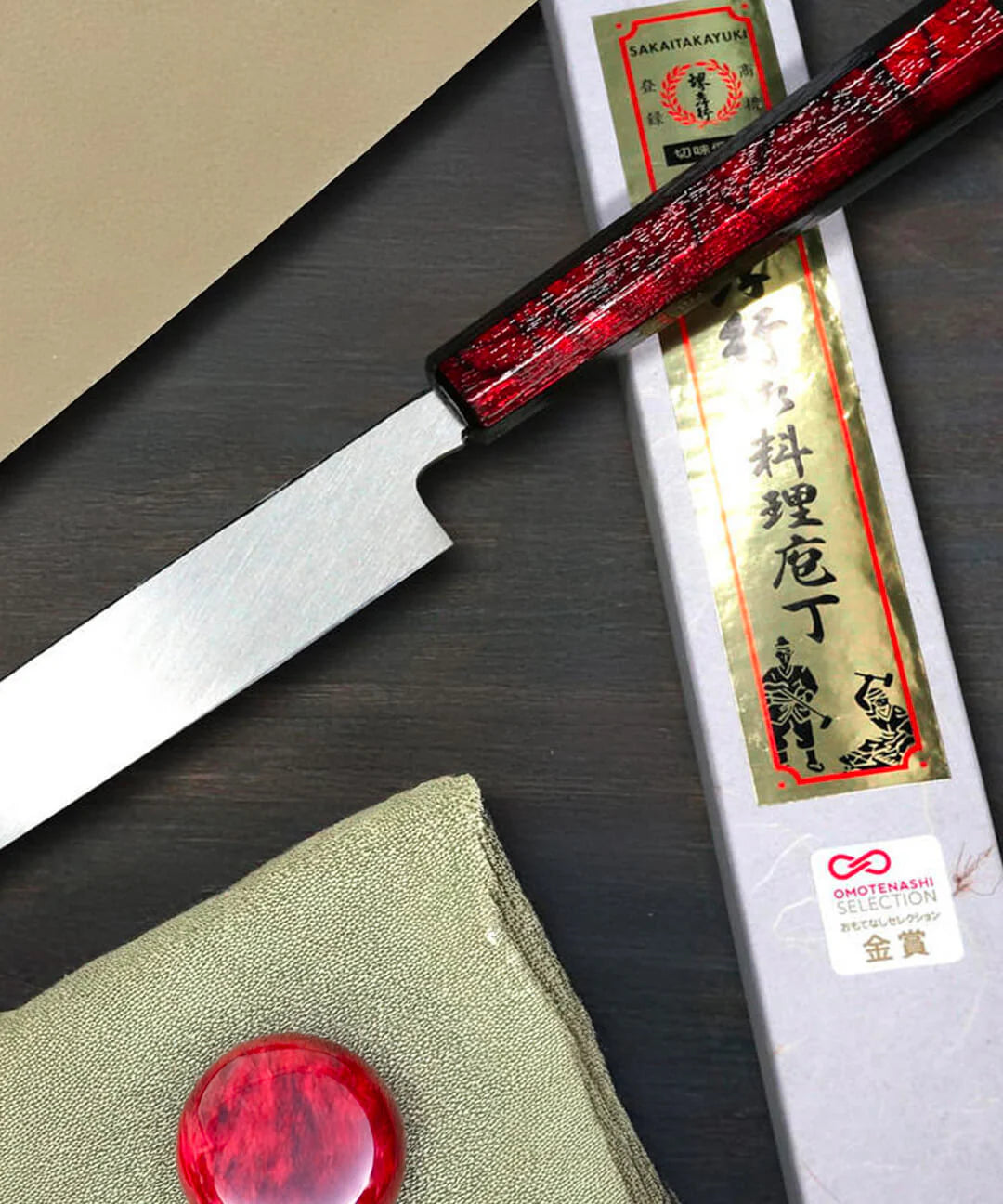
If you're thinking about getting into the world of Japanese knives, it's normal to feel overwhelmed by the sheer variety of options available. Each knife has a specific purpose, and choosing the right ones can make all the difference in your cooking experience. In this article, we'll help you select the essential knives for beginners, explaining their applications and why they're a great investment.
Why choose Japanese knives?
Japanese knives are known for their extreme sharpness, lightness, and elegant design. They are made from high-quality materials, such as carbon steel or advanced stainless steel, making them precise and long-lasting tools. Plus, their specialization for specific tasks makes them ideal for any type of kitchen.
The 3 essential knives for beginners
1. Gyuto (the all-rounder)
• Description: Similar to the Western chef's knife, the Gyuto is a versatile knife that can be used to cut meat, fish and vegetables. Its long, slightly curved blade facilitates both straight cuts and swinging motions.
• Why you need it: It's great for almost any kitchen task, so it can be your first and only Japanese knife if you're on a budget.
• Recommended for: Beginners looking for a unique, versatile knife.
2. Santoku (the jack of all trades)
• Description: The Santoku, whose name means “three virtues,” is designed for slicing, dicing, and filleting. It has a shorter, wider blade than the Gyuto, making it easier for users with smaller hands or less experience.
• Why you need it: Its compact design makes it easy to use and perfect for everyday use.
• Recommended for: Home cooks who prefer a lighter, more versatile option.
3. Petty (the small and precise knife)
• Description: A small and agile knife, ideal for precision tasks such as peeling fruit, chopping herbs or preparing garnishes.
• Why you need it: Round out your starter collection by taking care of tasks that the Gyuto or Santoku can't perform with the same precision.
• Recommended for: Those who want an extra knife for detailed work.
How to choose the right knife for you
1. Assess your cooking needs: Think about the types of foods you prepare most often and the style of cooking you practice.
2. Test the weight and balance: Look for a knife that feels comfortable in your hand. Gyuto knives are usually lighter than Western knives, making them easier to handle.
3. Blade Material: For beginners, we recommend high-grade stainless steel (such as VG10 or AUS10) for ease of maintenance.
4. Budget: While Japanese knives can be expensive, they are a long-term investment. Consider starting with a basic model and expanding your collection over time.
Tips to keep your knives in perfect condition
• Cleaning: Hand wash your knives immediately after use and dry them completely to prevent rust.
• Sharpening: Use Japanese sharpening stones to maintain the edge. A medium grit (1000-2000) is ideal for beginners.
• Storage: Store your knives in a wooden block, protective sheath, or on a magnetic holder to prevent damage.
Conclusion
Starting your Japanese knife collection is an exciting step for any cooking lover. With a Gyuto, Santoku, and Petty in your arsenal, you'll be prepared to tackle any recipe with confidence and precision.
At Ryo Miura Japan, we offer a carefully curated selection of Japanese knives for beginners and experts alike. Discover our collections and take the first step towards a unique culinary experience.
Visit store HERE